


Forty-four adolescents aged 12–17 years participated in the two co-design workshops: 25 at Workshop 1 and 19 at Workshop 2 (22 female, 22 male) (Table 1). The participants reported their social media preferences and created a range of digital health literacy storylines using storyboards containing images and/or text (Fig. 1). The themes and ideas explored in the workshops (Fig. 2) were used by the researchers and software designers to develop two new storylines for the “mis-Adventures” app (Fig. 3). These two new storylines were beta tested in the follow-up workshop, which was attended by eight of the previous workshop participants (2 female, 6 male) (Table 1) – all were from the first workshop, despite all previous participants having been invited. The themes identified were analysed further to understand adolescents’ digital health literacy education needs.

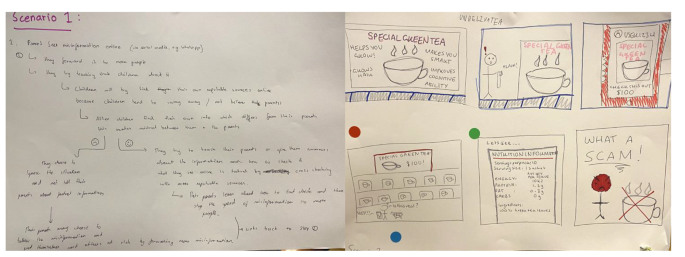
Examples of the novel design artefacts created in the co-design workshops containing storyboards depicting digital health literacy storylines about navigating online health information
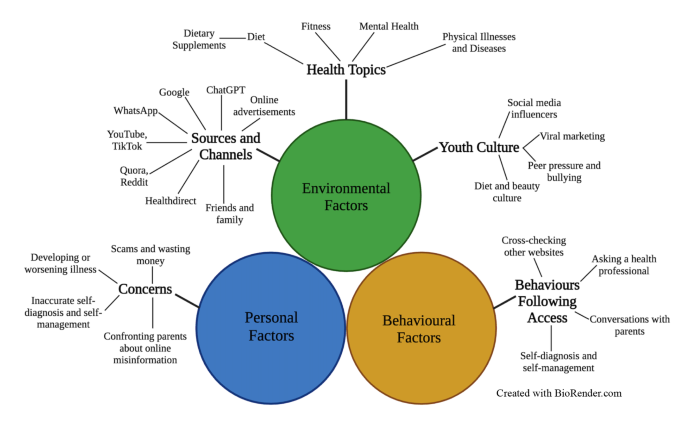
Thematic schema displaying themes and sub-themes identified in the analysis of the novel design artefacts as related to the three domains of Social Cognitive Theory
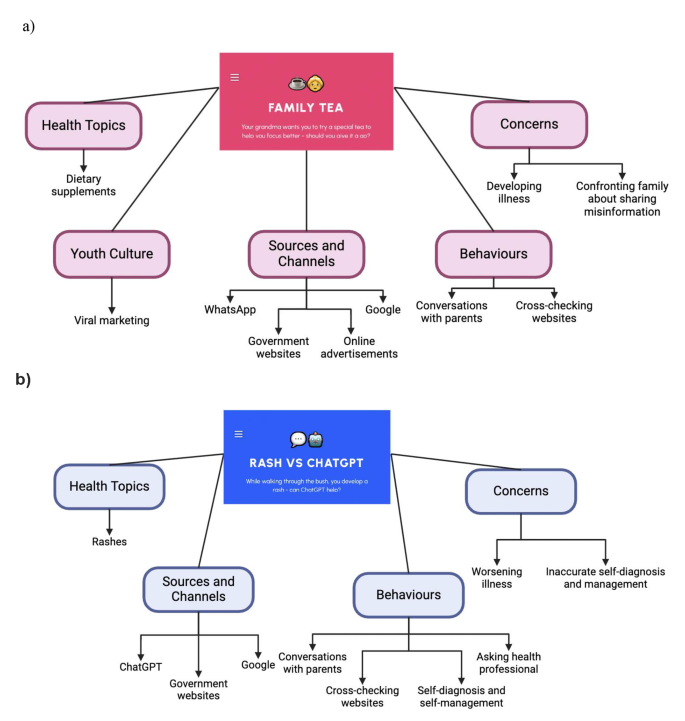
Themes and sub-themes from the data which were incorporated into the two new storylines for the “mis-Adventures” educational app: a) “Family Tea” and b) “Rash vs ChatGPT”
Health topics
A variety of health topics were explored in the storylines created in the co-design workshops. Diet was a common area of interest for many participants. In particular, dietary supplements such as sports drinks, energy drinks, protein powder and herbal remedies were a regular theme. Restrictive diets such as juice cleanses were also mentioned. Physical fitness and gym workouts further served as an undercurrent for many storylines related to diet and nutrition. Other storyline topics included mental health issues such as depression and attention deficit hyperactivity disorder (ADHD), physical illnesses such as acne, headaches, rashes and conjunctivitis, and more serious medical conditions such as seizures and cancer. Dietary supplements and rashes were the topics utilised for the new storylines developed in the app (Fig. 3).
Youth culture and online health information
The adolescent participants acknowledged the cultural contexts specific to their age group that inform their interactions with online health information. Multiple participants created storylines about the sports and energy drink brand Prime, which was founded by popular social media influencers. In these storylines, relationships with the influencers were demonstrated to have an impact on how an adolescent perceives health information, with their “idol” status and viral marketing strategies used to promote products that claim to benefit one’s health and fitness. The storylines showcased viral marketing strategies that further contributed to the “hype” surrounding certain products amongst the adolescent characters in the stories, who are thus motivated by peer pressure from their friends to purchase the product prior to any online appraisal of health information. Viral marketing was subsequently featured in one of the new “mis-Adventures” storylines (Fig. 3). Participants also mentioned the “toxicity” of diet culture and beauty culture in their storylines, which often informed engagement with health information surrounding nutrition and dietary supplements. They emphasised the role that peer pressure and bullying plays in formulating body standards and influencing how adolescents process health information. Vocabulary commonly used amongst young people such as “glowing up”, “in shape” and “bulked” was present in their storylines in relation to the promotion of restrictive diets and food products with supposed health benefits.
Sources and channels of online health information
Many avenues for seeking and finding health information, both online and offline, were mentioned by participants. When intentionally searching for health information, the storylines showed a proclivity towards asking family and friends, using online search engines like Google™, or looking up government-funded health websites with reliable, high quality health information that they deemed to be “official” and “verified”, such as Healthdirect [25]. In the posters annotated with participants’ social media preferences, there was also a strong inclination towards using video-sharing platforms like YouTube™ and TikTok™ when searching for health information, as well as question-and-answer websites like Quora™ and discussion forum websites like Reddit™. Artificial intelligence (AI) chatbots such as ChatGPT™, whilst frequently used by adolescents, were not as readily used for finding health information. However, many of the participants considered using ChatGPT in the future for this purpose. For this reason, a storyline created at the workshops was adapted into a “mis-Adventures” storyline using ChatGPT to search for health information and government-funded websites like Healthdirect for further fact-checking (Fig. 3).
Adolescents further identified online avenues where they were unintentionally exposed to health information. These primarily took the form of online product advertisements as well as brand promotions and product placements from influencers on social media platforms like Instagram™. Health information was also disseminated via conversations with friends and family members, particularly parents, either via alternative social media such as the messaging service WhatsApp™ or in-person. WhatsApp was used in a new “mis-Adventures” storyline in which a teenage character is inadvertently exposed to a health-related advertisement in a family group chat (Fig. 3).
Behaviours following access to online health information
The storylines showcased a range of possible actions that adolescent protagonists would take after their exposure to health information. If they accessed information in an offline setting, they would most likely use a search engine such as Google to investigate the topic or product further. For both online and offline health information, characters displayed their desire to cross-check using a range of sources they deemed reputable, often indicating their preference for websites with URL domains such as.gov or.org rather than.com to appraise the health information. Many of the storylines further involved searching for and engaging with a health professional, usually a doctor, to verify the health information. Conversations with parents were also apparent in a number of the storylines. Most interactions with parents in the storylines involved seeking advice from them, however some explored appraising viral online health misinformation disseminated by parents and using their newfound knowledge to educate them. Other storylines involved adolescents using the health information gained to self-diagnose a health condition and/or self-medicate. Discussions with parents and health professionals, cross-checking other websites and self-diagnosis and self-management featured in the new “mis-Adventures” storylines (Fig. 3).
Concerns relating to online health information
Many problems and negative outcomes related to accessing and appraising online health information were explored in the storylines devised. A recurring concern was the risk of false advertising and being scammed by online marketing and product placement on social media. Participants explained in their storylines that advertisements for certain products could contain unsubstantiated claims and hyperbole about their benefits for fitness and health. Dietary supplements were often featured in discussions about false health information conveyed through advertising, with particular concerns surrounding their nutritional content. In addition to this, participants emphasised the undesirable outcomes experienced when purchasing products that contain over-exaggerated health benefits, such as wasting money or discovering that the product has a poor taste. This further led to feelings of embarrassment and anger for the characters in their storylines.
Some storylines explored the possibility of developing an illness or exacerbating a current health problem if the characters followed incorrect health information. In worst case scenarios, the poor health advice resulted in hospitalisation and even death. These detrimental outcomes were often related to restrictive diets and supplements, however looking up symptoms and subsequently applying inaccurate health information via self-diagnosis and self-medication also resulted in worsening illness. These negative outcomes were explored in the new storylines developed for the app (Fig. 3). In the storylines concerning online health misinformation shared by adult family members, participants detailed their concern and apprehension about confronting their family and challenging their beliefs, identifying the potential for intergenerational distrust and tension to develop. This was subsequently included in one of the new “mis-Adventures” storylines (Fig. 3).
Evaluation of the “mis-Adventures” app
At the first two co-design workshops, participants reported that the existing “mis-Adventures” app contained engaging, informative and relevant content regarding online health information. They also enjoyed the design and interactive interface of the app, which they reported was easy to navigate. They appreciated the use of clear and understandable language throughout the storylines and found the quizzes and answer explanations embedded into the “problem-solving and decision-making” style of the storylines to be effective in reinforcing key lessons. In terms of improving the app, the participants reported that they would prefer a greater number of storylines on different topics, as well as greater depth, more difficult questions and more journey options for the storylines to explore. They also recommended subtitles and video controls such as pause, play and rewind be added to the video-based components of each storyline for accessibility.
At the beta-testing workshop held after the co-design workshops, participants confirmed that they recognised many of the ideas explored at their co-design workshop within the two new storylines created, specifically regarding the sharing of online misinformation and fact-checking using unreliable websites. The participants reported relating to the storylines in a range of ways, such as finding online advertisements for health-related products through social media and sharing by family members, with multiple participants stating that the stories resonated with them as they contained “actual problems” that they may encounter. They commented, however, that the use of ChatGPT for health information was more likely to be within the context of schoolwork and assessments rather than for everyday health concerns, as shown in one of the storylines. Participants expressed an appreciation for showcasing discussions about health information with family members in the storylines rather than just exploring one character’s online activity. The participants further stated that they were “engaged and entertained” by the new storylines and appreciated the casual nature of the dialogue. Participants reiterated the desire for more storylines exploring different topics. There were specific suggestions for “more realistic” storylines that incorporated the school environment in the search for online health information, such as a storyline involving the completion of a school assignment.
link