Whole mastic resin ameliorates halitosis and gingivitis in dogs and cats infected with Porphyromonas gulae
Preparation of the mastic
Chios mastic resin was provided by Sosin Co., Ltd. (Tokyo, Japan). For in vitro experiments, highly purified mastic was dissolved directly in the corresponding cell culture medium to ensure solubility and compatibility with bacterial or cell culture conditions, and then adjusted to final concentrations of 0.06–1%. For in vivo clinical trials, the mastic was dissolved in glycerin and cellulose gum (Sosin Co., Ltd.) to a final concentration of 5%. The vehicle gel, composed of glycerin and cellulose gum, was selected to match the physical properties of the mastic gel without containing active mastic resin, ensuring that any observed effects could be attributed to the resin itself rather than the gel base.
Bactericidal effects of mastic on P. gulae
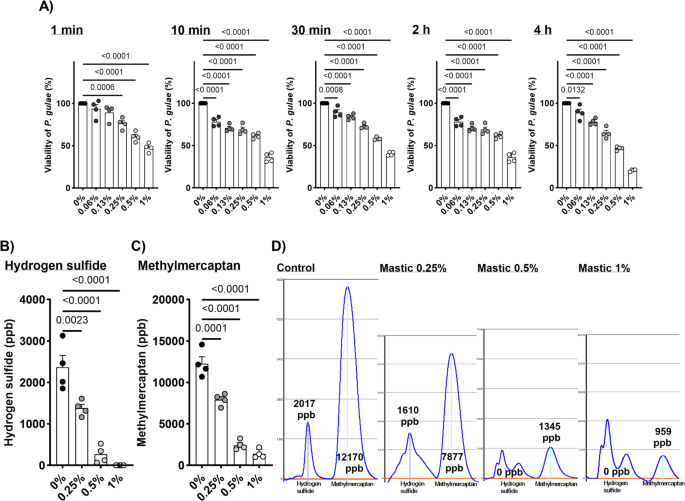
P. gulae strain ATCC 51,700 (fimA type A) was obtained from the Japan Collection of Microorganisms (RIKEN BioResource Research Center, Ibaraki, Japan). P. gulae was cultured anaerobically at 37 °C for 72 h in BD BBL™ CDC Anaerobic 5% Sheep Blood Agar (Becton, Dickinson and Company, NJ, USA) and horse red cell contained Brucella broth (KYOKUTO PHARMACEUTICAL INDUSTRIAL CO., LTD., Tokyo, Japan). The bactericidal effect of mastic on P. gulae was assessed using the BacTiter-Glo™ Microbial Cell Viability Assay (Promega KK., Tokyo, Japan), which quantifies viable bacterial cells based on ATP measurement. Following co-incubation of P. gulae suspensions with various concentrations of mastic (0.06%, 0.13%, 0.25%, 0.5%, and 1%) for 1 min, 10 min, 30 min, 2 h and 4 h, bacterial viability was determined by measuring luminescence using a GloMax®-Multi Detection System (Promega KK.). The emitted luminescence is directly proportional to intracellular ATP levels, allowing quantitative evaluation of viable bacterial cells. Decreased luminescence relative to untreated controls was interpreted as a bactericidal effect. Bacterial inocula were adjusted to an optical density at 600 nm (OD₆₀₀) corresponding to approximately 1 × 10⁸ CFU/mL, which reflects clinically relevant bacterial loads reported in subgingival plaque of dogs with moderate-to-severe PD18,34. Inocula were prepared in the same manner for all experiments, and equivalent OD₆₀₀ values were used to ensure comparability across replicates. This concentration was selected to reflect clinically relevant bacterial loads reported in subgingival plaque. Bacterial suspensions of P. gulae (1 × 10⁸ CFU/mL) were mixed with Brucella broth containing mastic (0.06–1%) and incubated for 1 min, 10 min, 30 min, 1 h, 2 h, or 4 h. Negative controls consisted of untreated bacteria incubated under identical conditions. Each condition was tested in quadruplicate, and experiments were independently repeated three times.
Inhibitory effects of mastic on hydrogen sulfide and methyl mercaptan production by P. gulae
Similarly, P. gulae suspensions (1 × 10⁸ CFU/mL) prepared as described above were co-incubated with mastic (0.25%, 0.5%, and 1%) for 5 min, and the production of hydrogen sulfide and methyl mercaptan was quantified using a gas chromatography system (OralChroma, Nissha FIS, Inc., Tokyo, Japan). Negative controls consisted of untreated bacterial suspensions, and buffer-only blanks were included to account for background. The direct deodorizing properties of mastic were assessed using a methyl mercaptan standard (FUJIFILM Wako Pure Chemical Corporation, Osaka, Japan). Each condition was tested in quadruplicate, and experiments were independently repeated three times.
Inhibitory effects of mastic on pro-inflammatory cytokine secretion by P. gulae- or lipopolysaccharide-induced murine and canine macrophage cell lines
J774.1 cell lines (mouse monocyte-macrophage) and DH82 cell lines (canine macrophage) were obtained from the American Type Culture Collection (Manassas, VA, USA). J774.1 cells were cultured in Roswell Park Memorial Institute (RPMI) 1640 medium (FUJIFILM Wako Pure Chemical Corporation) supplemented with 10% fetal calf serum (FCS; Sigma-Aldrich Co., LLC., Tokyo, Japan) and penicillin–streptomycin (FUJIFILM Wako Pure Chemical Corporation). DH82 cells were cultured in Eagle’s minimum essential medium (EMEM; FUJIFILM Wako Pure Chemical Corporation) supplemented with 10% FCS and penicillin–streptomycin. Both cell lines (1 × 10⁴ cells/100 μL) were exposed to mastic (0.13%, 0.25%, 0.5%, and 1%) and 1 × 10⁴ CFU/mL of P. gulae or 1 μg/mL of lipopolysaccharide (LPS, Sigma-Aldrich Co. LLC.) for 24 h. Cytokine concentrations in the supernatants of J774.1 and DH82 cells were quantified using DuoSet ELISA Development Systems (R&D Systems, Minneapolis, MN, USA): IL-1β (DY401), IL-6 (DY406), and TNF-α (DY410). Absorbance was measured at 450 nm with wavelength correction at 570 nm using a microplate reader. The cytotoxicity of the mastic used in this experiment was assessed using the Cytotoxicity LDH Assay Kit-WST (Dojindo Laboratories, Kumamoto, Japan) before conducting the cytokine release assay.
Inhibitory effects of mastic on P. gulae-induced phosphorylation of mitogen-activated protein kinase (MAPK) in J774.1
The phosphorylation levels of MAPKs including p38 and NFκB in J774.1 cells were measured 1 h after treatment with mastic (0.25%, 0.5%, 1%) treatment and exposure to 1 × 10⁴ CFU/mL of P. gulae using western blot analysis. Total proteins (30 µg) extracted from the cells using the M-PER™ Mammalian Protein Extraction Reagent (Thermo Fisher Scientific, Inc., Kanagawa, Japan) were separated using SDS-PAGE and transferred to PVDF membranes via Trans-Blot Turbo Transfer System (Bio-Rad Laboratories, Inc.). Primary antibodies (anti-phospho-p38, anti-p38, anti-phospho-NFκB, anti-NFκB, and anti-β-actin; Cell Signaling Technology, Inc., Danvers, MA, USA) were used for protein detection. They were visualized using a secondary antibody and then detected by ImmunoStar® Zeta (FUJIFILM Wako Pure Chemical Corporation). The iBright imaging system (Thermo Fisher Scientific) detected and quantified protein bands.
Daily oral mastic treatments in dogs and cats with P. gulae-positive PD
All animal experiments were approved by the Animal Care and Use Committee of Azabu University (Approval No. 200318-1). All procedures were performed in accordance with the ARRIVE guidelines ( and relevant institutional, national, and international regulations. Permission was obtained from all pet owners before including their pets in the study. Study designs are shown in Fig. 5A (dogs) and 6A (cats). The study included 40 dogs (ages 2–16 years, see Supplemental Table 1) and 15 cats (age 3–16 years, see Supplemental Table 2) with moderate-to-severe PD and no dental care during or within one month before the initiation of the clinical trial. Sample sizes (dogs: n = 40; cats: n = 15) were determined based on preliminary studies and a power calculation to detect significant changes in halitosis and gingivitis with 80% power at α = 0.05, accounting for potential variability in owner-administered gel application19,20,35. PD severity was classified by a licensed veterinarian based on AAHA dental care guidelines, using clinical signs of gingival inflammation and plaque accumulation. Scoring was performed by a single examiner blinded to treatment allocation. The dogs and cats were divided into two groups: daily mastic (5%)-containing gel treatment group (30 dogs and 10 cats) and daily vehicle control gel treatment group (10 dogs and 5 cats). Animals were randomly assigned to treatment or control groups using a computer-generated schedule, and all evaluators assessing gingivitis, plaque, and halitosis were blinded to group allocation. Pet owners were instructed to apply the gel daily but were not involved in outcome scoring. Dental gel was applied using the pet owner’s forefinger (no toothbrush or applicator was used) once daily for 30 min after the evening meal for 30–40 days. Owners were trained before the trial, and compliance was recorded in daily logs. Plaque and gingivitis were visually evaluated by a licensed veterinarian under standardized lighting conditions, based on the most severely affected teeth, using a 0–3 scale (0 = normal, 3 = most severe), without anesthesia or radiographs. No disclosing solution was used to avoid altering oral microbiota during the trial. The 30–40 day evaluation window was chosen to accommodate variation in owner compliance and the scheduling of follow-up visits, while still representing approximately one month of treatment. Gingivitis was scored according to redness, and swelling as follows: 0 = normal gingiva with no inflammation; 1 = mild gingival redness and swelling; 2 = moderate gingival redness and swelling; 3 = severe inflammation with marked redness and swelling. Plaque accumulation was scored as follows: 0 = no visible plaque; 1 = thin plaque deposit on tooth surface, detectable only after disclosing; 2 = moderate accumulation of soft deposits visible without disclosing; 3 = heavy plaque covering more than one-third of the tooth surface. A sensory evaluation was performed using questionnaires completed by pet owners after 30 days of treatment. Owners were asked to score their perception of halitosis and overall oral condition of their pets on a 5-point Likert scale (1 = very poor, 5 = very good). Hydrogen sulfide and methyl mercaptan levels in expired breath were measured using a gas chromatography system (Oral Chroma). P. gulae was detected in oral swab specimens collected from the gingival and/or subgingival margin and sulcus of the maxillary right or left canine and fourth premolar using a previously described polymerase chain reaction-based method19. Genomic DNA was extracted from each sample using the ISOFECAL kit (NIPPON GENE CO., LTD., Tokyo, Japan) and used as a template for two PCR assays: (i) a broad-range PCR targeting the 16S rRNA gene with primers 8UA and 1540R, and (ii) a targeted PCR using P. gulae-specific primers (forward: 5′-TTG CTT GGT TGC ATG ATC GG; reverse: 5′-GCT TAT TCT TAC GGT ACA TTC ACA). Reactions were performed in a total volume of 20 μL containing 2 μL of template DNA (20 μg/mL), Ex Taq DNA Polymerase (Takara Bio, Inc., Otsu, Japan), and primers, according to the manufacturer’s instructions. PCR amplification was carried out on a TaKaRa PCR Thermal Cycler Dice® Touch (Takara Bio, Inc.) using the following conditions for P. gulae-specific primers: initial denaturation at 95 °C for 4 min; 30 cycles of denaturation at 94 °C for 30 s, annealing at 62 °C for 30 s, and extension at 72 °C for 30 s; followed by a final extension at 72 °C for 7 min. Amplicons were separated on 1% agarose using the Invitrogen™ E-Gel™ Power Snap system (Thermo Fisher Scientific Inc.) and visualized with SYBR staining. The enzymatic activity hydrolyzing N-benzoyl-DL-arginine-naphthylamide (BANA), a marker for severe periodontal pathogens, including Treponema denticola, P. gingivalis, P. gulae, and Bacteroides forsythus, was assessed using the BANA test (BANAMet LLC, MI, USA)36.
Statistical analysis
All data are expressed as the mean ± standard error of the mean (SEM). To evaluate multigroup experiments for the in vitro study, we performed an analysis of variance (ANOVA), followed by Dunnett’s multiple comparison test. For the clinical research, we performed two-way ANOVA, followed by the uncorrected Fisher’s least significant difference test. Statistical significance was estimated at a 5% probability level. Data were analyzed using GraphPad Prism 10 (GraphPad Software, San Diego, CA, USA).
link